
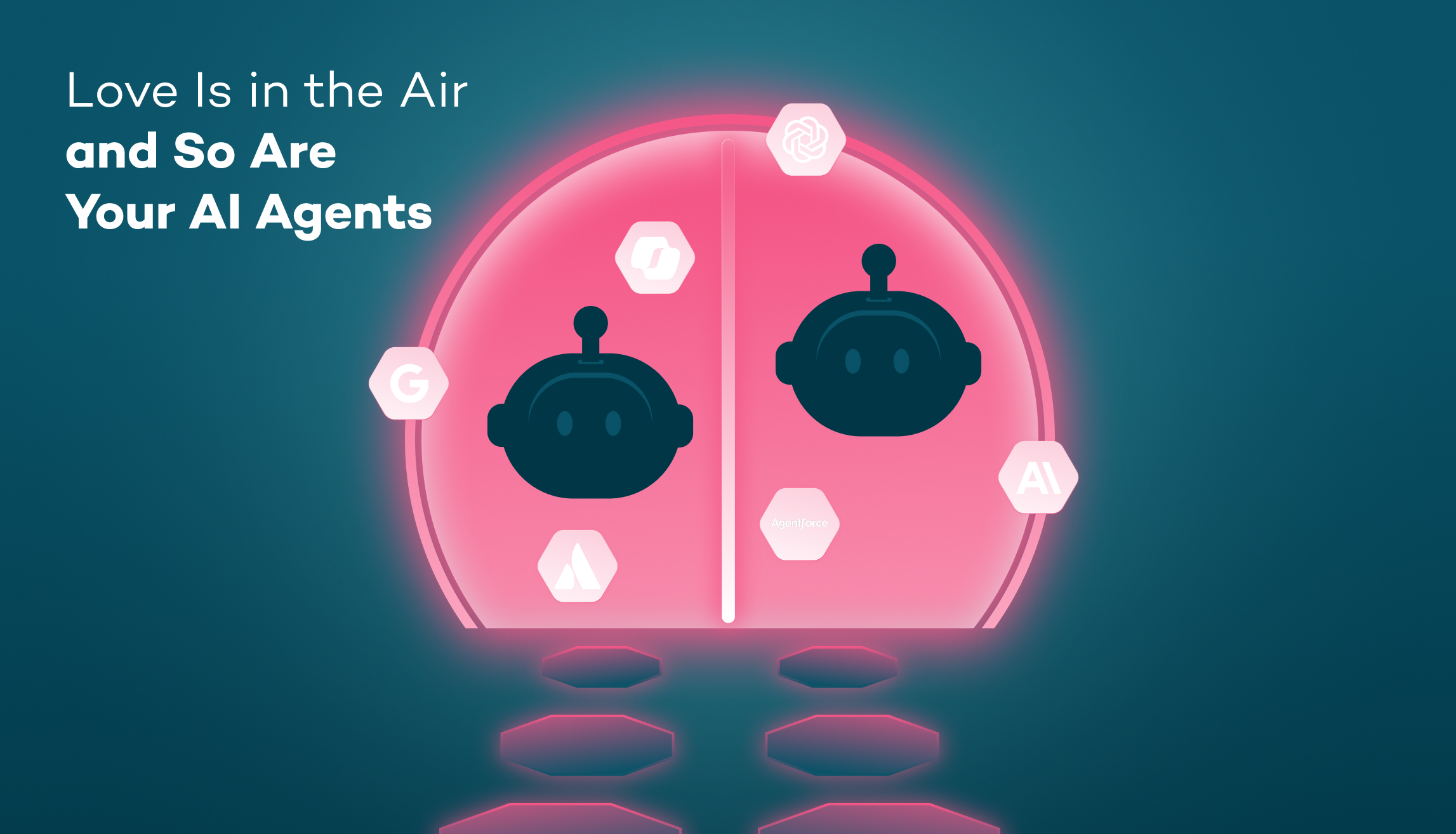
Valentine’s Day is all about chemistry. Finding the right match. Trying things out. Seeing what works before anything gets serious.
AI agents are going through a similar phase right now.
Across enterprises, teams are experimenting rapidly with AI agents, testing new frameworks, copilots, and integrations to see what sticks. These AI agents are being paired with SaaS platforms, APIs, MCP servers, and internal systems at record speed. Many are spun up as experiments. Some are meant to be temporary. A growing number quietly becomes permanent.
These agents aren’t only passive copilots. They authenticate. They take action. They create records, move data, change configurations, trigger workflows, and sometimes act on behalf of humans with broad privileges.
From a security perspective, this experimentation phase matters. What starts as a trial can quickly turn into a long-term relationship with real consequences.
In Love Is Blind, people commit to relationships before seeing the full picture, often based on early signals and strong promises made during an intense, accelerated experiment. Trust forms quickly, long before real-world behavior is fully understood. Sometimes it works. Often, it does not.
AI agents are being introduced into SaaS environments in much the same way. Access is granted, integrations are approved, and commitments are made while teams are still experimenting, often before security has full visibility into what those agents can actually see or do.
The New Matchmaking Problem: AI Agents and SaaS Access
Modern AI agents are rarely standalone. They are matched with SaaS applications through non-human identities, OAuth grants, API tokens, SaaS-to-SaaS integrations, and now through MCP servers. Each of these connections represents a trust decision. Who the agent is. What it can access. How long that access lasts. And what happens if the agent’s behavior changes.
The challenge is that many of these matches are happening outside of traditional security workflows. Teams spin up agents to improve productivity, automate business processes, or experiment with new AI capabilities. The integration works, value is delivered quickly, and security often finds out later.
At that point, the relationship is already official.
When Trust Moves Too Fast with AI Agents
The real risk is not just how AI agents are connected, but how quickly those connections become permanent.
What often begins as an experiment or short-term trial moves rapidly into production use. Access granted for convenience during testing is rarely revisited once the agent starts delivering value. Over time, temporary decisions quietly harden into long-lived trust.
As a result, AI agents frequently retain more access than intended, for longer than expected, and across more systems than anyone originally planned.
This shows up as overprivileged OAuth scopes that were never reduced, long-lived tokens that outlast their original purpose, and shared service accounts reused across multiple agents and workflows. Visibility into downstream SaaS-to-SaaS access fades as environments evolve.
This is the equivalent of moving in together before anyone has talked about boundaries. Unlike human users, AI agents do not pause or self-correct. They execute continuously based on the access they have been given. When behavior changes or an agent is compromised, the blast radius is determined by accumulated access, not by the original intent behind it.
The Bachelor Problem: Too Many Roses to Vet AI Agents at Scale
On The Bachelor, the problem is not choice. It’s accelerated commitment.
Dozens of candidates arrive at once. Early impressions matter more than long-term compatibility. Roses are handed out based on limited information, and serious commitments are made before anyone has seen how these relationships hold up outside the mansion.
AI agents enter SaaS environments the same way.
New agents, copilots, and AI-driven automations appear quickly across teams. Each one requests access through OAuth, APIs, service accounts, or MCP access. Many look legitimate. Most promise efficiency. Very few are deeply vetted.
Without continuous visibility, security teams are left managing a growing pool of agents that appear acceptable on the surface but carry very different levels of risk.
This makes it difficult to answer foundational questions:
- Which AI agents exist across our environment?
- Which applications and integrations are they connected to?
- What scopes, roles, and entitlements have they been granted?
- Are those permissions still aligned with least privilege?
This is not just an AI challenge. It is an identity and access problem compounded by SaaS sprawl, SaaS-to-SaaS trust, and non-human identities acting at scale.
What a Healthy AI Agent Relationship Looks Like
Securing AI agents does not mean saying no to innovation. It means setting boundaries early and enforcing them consistently.
A strong foundation includes:
Continuous Discovery
Visibility into AI agents, non-human identities, and SaaS-to-SaaS integrations as they appear, including agents operating through APIs, MCP sessions, and SaaS-native automation features.
Identity-Centric Risk Posture
Understanding the ongoing identity posture of AI agents, including how they authenticate, what roles and scopes they hold, and how that access aligns with least-privilege expectations over time.
SaaS-to-SaaS and OAuth Risk Context
Understanding OAuth grants, token lifetimes, and cross-application trust paths, especially where AI agents broker access and move data between SaaS platforms.
Policy-Controlled Remediation
Reducing risk through clear and flexible remediation options, such as adjusting OAuth scopes, rotating credentials, disabling unnecessary integrations, and routing actions through policy-driven workflows aligned to existing IT and security processes.
Ready for Better Matchmaking between AI Agents and SaaS?
AI agents are forming connections with your SaaS environment every day. Some are thoughtful, well-scoped, and intentional. Others move fast, inherit more access than they need, and stay connected long after anyone remembers approving the relationship.
The difference is not whether you adopt AI. It’s whether you understand who your agents are matched with, what trust they have been given, and whether those permissions still make sense.
Valence helps security teams gain continuous visibility into AI agents, non-human identities, and SaaS integrations, apply identity-centric risk context, and remediate risky access through flexible, policy-controlled workflows as environments evolve.
If you want to support AI adoption without blind trust, schedule a demo to learn how Valence helps organizations secure SaaS and AI in the agentic era.